|
|
 |
 |

|
|
|
||||
| ||||
|
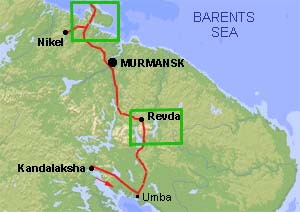
The scheme of the travelTo enlarge the borderedparts, click on them
|
|
Travellers are a separate species, but there is no doubt that they are human. It is not the appearance that makes them different: they are bipedal and descended from an ape as you or me, it is the willing of their soles. However this summer the members of St. Petersburg Travellers' Federation decided to spend a vacation as everyone else. Usually people like to rest somewhere with a lot of sun, fresh air, mountains and a seacoast. In Russia there is a place that meets all these requirements — the Kola Peninsula — deep beyond the pole-around. It lies between the two seas: the White Sea in the south and the Barentsevo Sea in the north. Its beaches stretch for kilometers and are absolutely empty. Exactly in the midland there are the mountains — Lovozero tundra. And the sun shines eternally in summer! There is no better place to organize an expedition "To the last northern point of Russian Europe — Nemetsky cape".
Our expedition started in a small seaside town of Kandalaksha at the end of the first august fortnight. Sasha remembered this charming place better than anyone else did as all his possessions besides clothes were stolen there. Thus he challenged the Kola peninsula in "alpine style". He even received a new nickname — Bicycleman — since he slept in two bicycle bags instead of a sleeping bag.
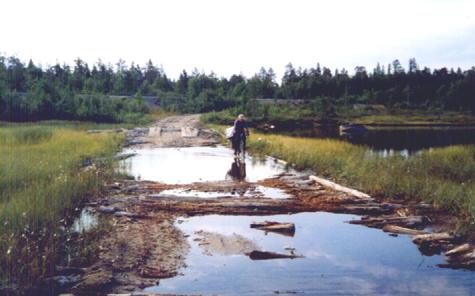
The natives of Kola Peninsula are kindhearted and eager to help, but there is one strange thing about them. Each time you try to ask someone about the road he puts a strange smile on, makes wide gestures and mutters something about off-road vehicles and ice roads. Sometimes our questions brought sweet memories to life: "Yes, it was in the year before granny died, 1973 it was, and we drove 150 km to the very end of this road in a lorry in no more than a week. And don’t listen to the neighbor, he just got to the middle the year before last." Inspired by these descriptions we took one of the ground roads north. It started from simply bad quality and later turned out somewhat between "absolutely impossible to ride" and "possible to ride if you Really want it".
|
|
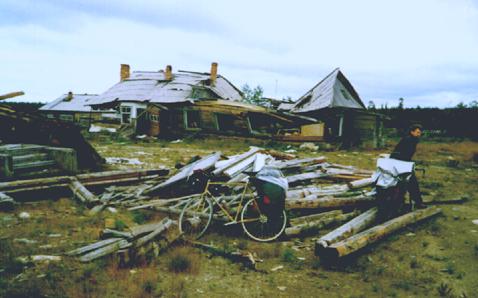
Heaven for bikers. Are you through these stones? Here is a marsh covered with rotten wood! Did you manage to climb up that sandy hill? Take that crooked road down to the shallow ford, please! No time to get bored. Cultural entertainment was also present: uninhabited village, for instance. People lived here and some of them still return to spend a summer in their house and live from the surrounding forests and lakes. In the other village we met a farmer and his son or grandson. To the merits of the region they were rich — they owed a telephone.
|
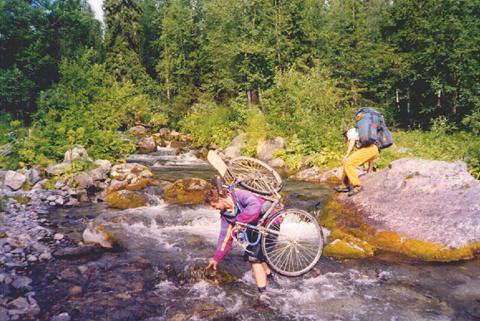
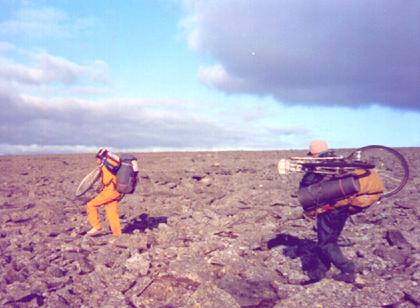
Finally we got to Umbozero-lake. Our further route lead to Revda-town but not along the "road" that ran along the lake, but across the mountains. There was not even a trail there and no aborigines to plant seeds of doubt into our soles. Thus over the next three days on our own experience we had to learn that one can hardly ride a bicycle in Lovozero tundra. There the bicycles rest on the shoulders of their owners. It was even impossible to roll the bikes over heaps of stones. The bicycles were a disaster, but we found them some applications on extremely steep gradients. We would stick the bicycle in the stones and make a few steps up holding to it. Then moved the bike further. We recommend this method to all mountaineers. Why not take you two-wheel friend with you? It is especially good for finding a fast way down. We had an experience in that, too. When we approached the valley that lead to Elmaraiok mountain pass, a few meters of stonewall separated us from appealing road. The bicycles looked so comfortable when they slowly descended on the ropes operated by Viktor Shults.
Over the pass we discovered an asphalt road. It went down and the wind pushed us in the back. We easily made 50 km/h when I bumped into a pile of dry concrete behind a turn. The front wheel did not stand the impact and I first found myself on the road and then at the nearest surgery. It looked like a dream. The surgeon tells the assistant: "Give me "this kind" of scalpel". Assistant: "There’s no. May be you can use the scissors." Surgeon: "What do you mean? Give me another scalpel and thin threads!" Assistant: "We have only these threads." Surgeon: "These are fit for an elephant!" Assistant: "But he is a large guy." I was happy that my wound was on the head and I saw neither the scalpel nor the "elephant threads".
We had to stop our progress north and decide whether I could continue the trip. I was lying at the hotel and thinking. On one side, a head is not a leg and thus is not very important for a cyclist. On the other, such condition increased my chances to fall down again and have something wrong with the leg this time… My friends showed signs of cowardliness. They walked by my bed and talked of what a wonderful trip they had completed, that there was a very comfortable coach from Revda to Olenegorsk, and we would be almost home… (Being back home they confessed that they believed I could not think clearly even when I first planned the trip, that after the accident it would get even worse and I would insist on reaching that last northern point of Europe, that though the head is something one can hardly understand it is still worth taking care of.) Thoughts of going back made me feel like mounting my "golden stallion" and we started out for Nemetsky cape next day.

|
Gradually along the Slava Valley and following Titovka River we entered the tundra zone on Sredny Peninsula. During long years of cold war with "imperialistic enemy" across the Norwegian boarder this area became an ecological disaster. The ruins of military equipment, oil barrels, barbed wired storages with something dangerous at the first glance. We tried even not to look in their direction and continued struggling with the road. And the road decided to give us another treat — steep sand-and-stone mountain pass first to climb up and then to go down. Down it was a slalom championship for "Big Thanks of Expedition Mechanic Volodya Voronkov" - prize. The winner was the one who managed to make another few turns of the road with a safe bicycle. Thought the prize was worthy, Volodya had to demonstrate the best of his skills making the wheels at least rotate in the forks.
To get on Rybachy Peninsula one has to show the admission at the boarder control. In the communist days getting the admission was extremely difficult but now the guards just glanced at the papers and wished us good luck. They swore that nothing on Earth could make them take our route.
|
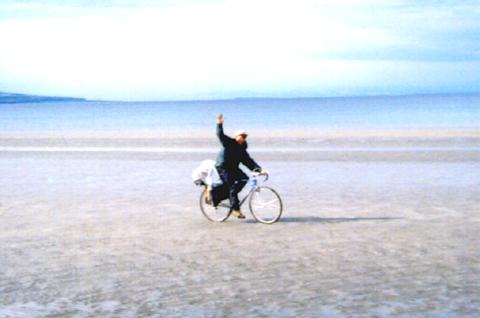
On Rybachy we saw ruins that clearly indicated that people had lived there. They bred barbed wire, grew radio-rangers and grazed herds of off-road vehicles whose skeletons add beauty to the surrounding landscape. Lately, possibly due to inevitable climate changes, the population migrated south and left their barrack houses in "late stagnation" style to the northern winds. Only not far from the last northern point of Russian Europe we first discovered life. The little hamlet bore a poetic name of Vaida-Guba. A wide central street was called Rybachy Heroes Prospect. There all town sites were situated: two brick double floor buildings, a military hospital (very good in head bandaging), a barrack and a house with a chimney where Diesel-generator lived. Its low growl was heard from far away. Right behind the village there began a garbage dump that stretched all the way to Nemetsky cape. I started to believe that on the last eastern, southern and western points of our vast country there are also garbage dumps (or at least a scrap heap near by). Hardly we found a place with no signs of Soviet man presence and took a photograph by the black stones towards the Arctic Ocean…
Back.
How good it is to be homeward bound! How unexpected it turns out to be back! But let me tell it step by step.
|
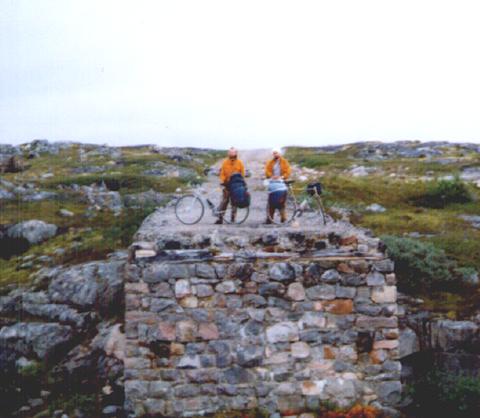
We had to cross a piece of mountainous tundra to get to the railroad station. Roads were especially good in that region. I asked one man if it was possible to get to Pechenga. He said that actually it was possible: "Not long ago two people on a motorbike tried and came back, the others on "Russian jeep" went there a week ago and did not return, may be they finally got to Pechenga. The road by itself is not bad, but the Nazis burnt the bridges…" "What Nazis?" — asked I. "Well, they left the peninsula and burnt all bridges behind." — "But that was 54 years ago!" — "So what, this doesn’t return the bridges."
We found out that it was true when on the other side of the bay we saw the lights of Pechenga. It seemed that we could be at the railway station before darkness. However a river forty meters wide separated us from it. There was no bridge and ice-cold water was too deep. For three and a half hours we waited for the low tide to drop the water to waist level and give us a chance to get to the other side. Alas, we were an hour and forty minutes late for the daily train! Luck did not follow us in this trip...
At home we found the economy of our country in ruins, government in collapse and people in panic. Regular Russian life went on.
by Ilia Gourevitch (English text by Anna Orlova)
View additional pictures
|